
Introduction
If you're a digital nomad, expat, or international traveler, you've probably heard about the 183-day rule. This seemingly simple threshold can have profound implications for your tax obligations, determining whether you become a tax resident in a country—and potentially subject to taxation on your worldwide income.
According to recent studies, 62% of digital nomads are unaware of how the 183-day rule affects their tax status, leading to unexpected tax bills and compliance issues. Understanding this rule is crucial for anyone spending significant time across multiple countries.

In this comprehensive guide, you'll learn:
- What the 183-day rule is and why it matters
- How different countries apply the rule
- Common exceptions and special cases
- How to accurately count your days
- Practical strategies to avoid accidental tax residency
- Tools to help you track your tax residency status
Let's dive in.
What is the 183-Day Rule?
The 183-day rule is a common threshold used by many countries to determine tax residency. In its simplest form, if you spend 183 days or more in a country during a tax year (typically a calendar year), you may become a tax resident of that country.
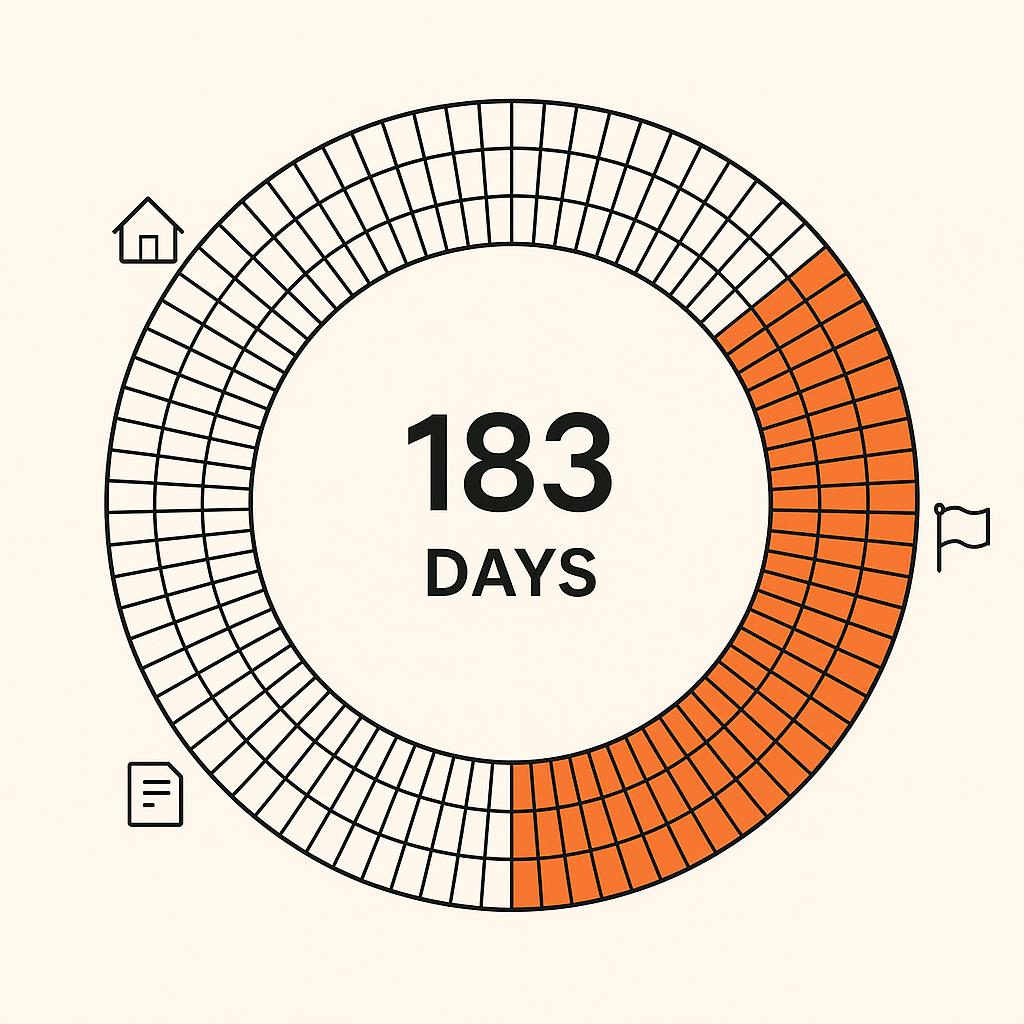
This circular calendar illustrates how 183 days represents exactly half of the year plus one day. The highlighted section shows the threshold that triggers tax residency in most jurisdictions.
Why 183 Days?
The number 183 represents just over half a year (365 days ÷ 2 = 182.5 days). The logic is straightforward: if you spend more than half the year in a country, you have a substantial connection to that jurisdiction and should contribute to its tax system.
Tax Residency vs Citizenship
It's important to understand that tax residency is different from citizenship or nationality:
- Citizenship is your legal status as a member of a country, usually determined by birth or naturalization
- Tax residency is where you're obligated to pay taxes, determined by your physical presence and economic ties
You can be a citizen of one country but a tax resident of another. Conversely, you can be a tax resident of a country where you're not a citizen.
Consequences of Tax Residency
Becoming a tax resident typically means:
- Worldwide income taxation: You may need to pay taxes on all your income, regardless of where it's earned
- Tax filing obligations: You must file annual tax returns in that country
- Social security contributions: You may be required to contribute to the country's social security system
- Double taxation risk: If you're a tax resident in multiple countries, you could face taxation on the same income twice (though tax treaties often prevent this)
How the 183-Day Rule Works in Different Countries
While the 183-day threshold is common, each country applies it differently. Let's explore how major jurisdictions implement this rule.
United States: Substantial Presence Test
The US uses a more complex calculation called the Substantial Presence Test (SPT):
Formula:
Current year days × 1
+ Prior year days × 1/3
+ Year before prior × 1/6
= Substantial Presence
If the total equals 183 days or more, you're generally considered a US tax resident.
Example:
- 2026: 120 days in the US
- 2025: 90 days in the US
- 2024: 60 days in the US
Calculation:
- 120 × 1 = 120
- 90 × 1/3 = 30
- 60 × 1/6 = 10
- Total = 160 days (below 183, not a tax resident)
Exceptions:
- Students on F, J, M, or Q visas
- Teachers and trainees
- Professional athletes competing in charitable events
- Individuals with closer connections to another country
Official source: IRS Publication 519
United Kingdom: Statutory Residence Test
The UK uses the Statutory Residence Test (SRT), which is more nuanced than a simple day count. It considers:
- Automatic UK residence if you spend 183+ days in the UK during the tax year (April 6 - April 5)
- Automatic overseas residence if you spend fewer than 16 days in the UK
- Sufficient ties test for those between 16-182 days, considering:
- Family ties (spouse/children in UK)
- Accommodation ties (UK home)
- Work ties (working in UK)
- 90-day tie (spent 90+ days in UK in either of previous 2 years)
- Country tie (spent more days in UK than any other country)
The more ties you have, the fewer days needed to become UK tax resident.
Official source: HMRC Guidance
Germany: 183-Day Rule with Qualifications
Germany applies the 183-day rule, but also considers your "center of vital interests":
- 183+ days in Germany → likely tax resident
- Permanent home in Germany → likely tax resident
- Center of vital interests (family, economic ties) in Germany → likely tax resident
Even if you spend fewer than 183 days in Germany, you can still be considered a tax resident if your personal and economic ties are primarily there.
Official source: German Federal Ministry of Finance
Spain: 183-Day Rule
Spain's rule is straightforward:
- Spend 183+ days in Spain during a calendar year → tax resident
- Economic interests primarily in Spain → tax resident (even if fewer than 183 days)
- Spouse and dependent children live in Spain → presumed tax resident
Spain counts any part of a day as a full day for tax purposes.
Official source: Agencia Tributaria
France: 183-Day Rule Plus
France considers you a tax resident if:
- Your principal home (foyer) is in France, OR
- Your principal place of residence is in France (183+ days), OR
- Your principal professional activity is in France, OR
- Your center of economic interests is in France
Official source: Impôts.gouv.fr
Canada: Residential Ties
Canada doesn't have a strict 183-day rule. Instead, it focuses on residential ties:
Primary ties:
- Home in Canada
- Spouse or common-law partner in Canada
- Dependents in Canada
Secondary ties:
- Personal property (car, furniture)
- Social ties (memberships, affiliations)
- Economic ties (bank accounts, credit cards)
- Driver's license
- Health insurance
Even spending less than 183 days in Canada can make you a tax resident if you have significant ties.
Sojourner rule: If you spend 183+ days in Canada without significant ties, you're deemed a tax resident for that year only.
Official source: Canada Revenue Agency
Australia: Resides Test
Australia uses a "resides" test rather than a strict day count:
- Resides test: Do you reside in Australia based on ordinary meaning?
- Domicile test: Is Australia your domicile unless you have a permanent place of abode outside Australia?
- 183-day test: Did you spend 183+ days in Australia with intention to reside?
- Superannuation test: For government employees
Official source: Australian Taxation Office
Portugal: 183-Day Rule
Portugal's rule is clear:
- Spend 183+ days in Portugal (consecutive or not) during a 12-month period → tax resident
- Have a habitual residence in Portugal on December 31 → tax resident
Portugal also offers the Non-Habitual Resident (NHR) program, which provides tax benefits for new residents.
Official source: Autoridade Tributária e Aduaneira
UAE: 183-Day Rule (New)
As of 2023, the UAE introduced tax residency criteria:
- Spend 183+ days in UAE during a 12-month period, OR
- Spend 90+ days in UAE AND have a residence permit, employment, or business
The UAE has 0% personal income tax, making it attractive for digital nomads and expats.
Official source: UAE Federal Tax Authority
Comparison Table: 183-Day Rule by Country

| Country | Threshold | Additional Criteria | Tax Year |
|---|---|---|---|
| United States | 183 days (SPT formula) | Substantial Presence Test | Jan 1 - Dec 31 |
| United Kingdom | 183 days | Sufficient ties test | Apr 6 - Apr 5 |
| Germany | 183 days | Center of vital interests | Jan 1 - Dec 31 |
| Spain | 183 days | Economic interests | Jan 1 - Dec 31 |
| France | 183 days | Principal home/activity | Jan 1 - Dec 31 |
| Canada | 183 days (sojourner) | Residential ties | Jan 1 - Dec 31 |
| Australia | 183 days | Resides test | Jul 1 - Jun 30 |
| Portugal | 183 days | Habitual residence | Jan 1 - Dec 31 |
| UAE | 183 days or 90 days | Residence permit/employment | Jan 1 - Dec 31 |
Exceptions and Special Cases
1. Day of Arrival and Departure
How to count:
- Most countries: Count both arrival and departure days as full days
- Some countries (like Spain): Any part of a day counts as a full day
- Best practice: Count both arrival and departure days to be conservative
Example:
- Arrive in Spain: March 15
- Depart from Spain: March 17
- Days counted: 3 days (March 15, 16, 17)
2. Transit Days
General rule: Days spent in transit (passing through an airport) typically don't count unless you leave the airport or stay overnight.
Exception: Some countries count any presence, even in transit.
3. Days Spent on International Waters
Days spent on cruise ships or in international waters don't count toward any country's 183-day threshold.
4. Students and Teachers
Many countries have exemptions for students and teachers on temporary visas. For example:
- US F-1 students: Exempt from Substantial Presence Test for 5 years
- UK students: May claim non-residence despite 183+ days
5. Government Employees
Government employees working abroad are often considered tax residents of their home country, regardless of days spent abroad.
6. Treaty Tie-Breaker Rules
If you're a tax resident in multiple countries, tax treaties provide tie-breaker rules:
- Permanent home: Where is your permanent home?
- Center of vital interests: Where are your personal and economic ties stronger?
- Habitual abode: Where do you habitually live?
- Nationality: Which country are you a national of?
- Mutual agreement: Tax authorities decide
How to Count Your Days Accurately

Proper tracking is essential to avoid accidentally becoming a tax resident where you don't intend to be. Here are the most effective methods:
Method 1: Manual Tracking
Tools needed:
- Calendar or notebook
- Passport stamps (if available)
Process:
- Record every entry and exit date
- Count days between arrival and departure (inclusive)
- Sum up days per country per year
Pros: Simple, no technology needed Cons: Error-prone, time-consuming
Method 2: Spreadsheet
Tools needed:
- Excel or Google Sheets
Template:
| Country | Arrival Date | Departure Date | Days | Notes |
|---|---|---|---|---|
| Spain | 2026-01-15 | 2026-02-28 | 45 | Barcelona |
| Portugal | 2026-03-01 | 2026-04-15 | 46 | Lisbon |
| Spain | 2026-04-16 | 2026-06-30 | 76 | Madrid |
Formula for days:
=DAYS(Departure_Date, Arrival_Date) + 1Pros: Flexible, can add custom calculations Cons: Manual data entry, no automation
Method 3: Apps and Tools
Options:
- Flamingo ($4.99/month) - iOS app for tax residency tracking
- TaxBird ($9.99/month) - Comprehensive tax residency tracker
- Days of Stay (FREE) - Privacy-first web app, no signup required
Pros: Automated calculations, alerts, multi-country support Cons: Some require subscriptions
Method 4: Days of Stay (Recommended)
Why Days of Stay?
- ✅ 100% Free - No hidden costs, no subscriptions
- ✅ Privacy-first - All data stored locally in your browser
- ✅ No signup required - Start tracking immediately
- ✅ 195+ countries supported - Track anywhere in the world
- ✅ Schengen calculator - Built-in 90/180 rule tracking
- ✅ Tax residency alerts - Get notified before reaching 183 days
- ✅ Export data - Download your records for tax filing
How to use:
- Visit daysofstay.com/app
- Add your trips (arrival and departure dates)
- View days by country automatically
- Set alerts for 183-day thresholds
- Export your data when needed
→ Start tracking your days with Days of Stay (FREE)
Common Mistakes to Avoid
Mistake 1: Not Counting Partial Days
Error: Only counting full days spent in a country Reality: Most countries count arrival and departure days as full days
Example:
- Arrive: December 31, 2026
- Depart: January 1, 2027
- Correct count: 1 day in 2026, 1 day in 2027 (total 2 days)
Mistake 2: Ignoring Multiple Tax Residencies
Error: Assuming you can only be a tax resident in one country Reality: You can be a tax resident in multiple countries simultaneously
Solution: Use tax treaty tie-breaker rules to determine primary tax residence
Mistake 3: Relying Only on Passport Stamps
Error: Using passport stamps as the sole record Reality: Many countries (especially within Schengen) don't stamp passports
Solution: Keep independent records of all travel
Mistake 4: Not Considering Economic Ties
Error: Focusing only on physical presence Reality: Many countries also consider where you earn income, own property, or have family
Example: Spending 150 days in Spain but earning all income from Spanish clients → likely tax resident
Mistake 5: Forgetting About Previous Years
Error: Only tracking current year days Reality: Some countries (like the US) use multi-year formulas
Solution: Track at least 3 years of travel history
Practical Strategies to Avoid Accidental Tax Residency
Strategy 1: The 182-Day Rule
Approach: Stay in each country for a maximum of 182 days per year
Benefits:
- Avoids triggering 183-day rule in most countries
- Maintains flexibility
- Reduces risk of dual tax residency
Considerations:
- Some countries have lower thresholds (e.g., 90 days with economic ties)
- Doesn't account for tie-breaker rules
Strategy 2: Establish a Low-Tax Base
Approach: Become a tax resident in a low-tax or no-tax jurisdiction
Options:
- UAE (0% personal income tax)
- Portugal (NHR program - 0-20% for 10 years)
- Cyprus (non-dom status - 0% on foreign income)
- Panama (territorial taxation)
Benefits:
- Legal tax optimization
- Clear tax residency status
- Often easier to obtain tax residency certificates
Strategy 3: Use Tax Treaties
Approach: Understand tax treaties between your citizenship country and countries you visit
Benefits:
- Prevents double taxation
- Provides tie-breaker rules
- May offer reduced withholding rates
Resources:
Strategy 4: Keep Detailed Records
Approach: Document every trip meticulously
What to track:
- Entry and exit dates
- Purpose of visit (tourism, work, family)
- Accommodation addresses
- Income earned in each country
- Days spent in each country
Tools:
- Days of Stay (automated tracking)
- Google Calendar (manual tracking)
- Travel receipts and boarding passes
Strategy 5: Set Up Alerts
Approach: Get notified before reaching critical thresholds
Example alerts:
- 150 days in a country (warning)
- 175 days in a country (urgent)
- 90 days in Schengen (for 90/180 rule)
How: Use Days of Stay's built-in alert system
Real-World Examples
Example 1: Digital Nomad in Europe
Profile:
- US citizen
- Travels through Europe
- Works remotely for US company
2026 Travel:
- Spain: 90 days
- Portugal: 60 days
- France: 45 days
- Germany: 30 days
- Italy: 40 days
- Total: 265 days in Europe (within Schengen 90/180 rule with breaks)
Tax residency:
- US: Likely still tax resident (citizen-based taxation)
- Spain: Not tax resident (< 183 days)
- Portugal: Not tax resident (< 183 days)
- Other countries: Not tax residents
Result: Remains US tax resident only, files US taxes on worldwide income
Example 2: Expat in UAE
Profile:
- British citizen
- Works in Dubai
- Has UAE residence visa
2026 Presence:
- UAE: 200 days
- UK: 60 days (visiting family)
- Other countries: 105 days (travel)
Tax residency:
- UAE: Tax resident (183+ days + residence visa)
- UK: Not tax resident (< 183 days, no sufficient ties)
Result: UAE tax resident with 0% personal income tax, no UK tax obligations
Example 3: Accidental Tax Resident
Profile:
- Canadian citizen
- "Traveling" while working remotely
2026 Presence:
- Spain: 190 days
- Other countries: 175 days
Mistake: Didn't track days carefully, exceeded 183 days in Spain
Tax residency:
- Canada: Possibly still tax resident (residential ties)
- Spain: Tax resident (183+ days)
Result: Dual tax residency, potential double taxation, needs to use Canada-Spain tax treaty tie-breaker rules
Lesson: Track days proactively to avoid surprises
Frequently Asked Questions
1. What happens if I exceed 183 days in a country?
If you exceed 183 days, you'll likely become a tax resident of that country. This means:
- You must file a tax return
- You may owe taxes on worldwide income
- You may need to pay social security contributions
- You should obtain a tax residency certificate
Action: Consult a tax professional to understand your obligations and use tax treaties to avoid double taxation.
2. Can I be a tax resident in two countries at once?
Yes, it's possible to be a tax resident in multiple countries simultaneously. This is called dual tax residency.
Solution: Tax treaties between countries provide tie-breaker rules to determine your primary tax residence:
- Permanent home
- Center of vital interests
- Habitual abode
- Nationality
3. Do transit days count toward the 183-day rule?
Generally no, if you're just passing through an airport without leaving the transit area.
Exception: If you leave the airport, stay overnight, or the country specifically counts transit days, they may count.
Best practice: Don't count pure transit days, but document them in case of questions.
4. How do I count the day I arrive and depart?
Most countries: Count both arrival and departure days as full days.
Example:
- Arrive: June 1
- Depart: June 3
- Days counted: 3 days (June 1, 2, 3)
Conservative approach: Always count both days to avoid underestimating.
5. What if I don't have passport stamps?
Problem: Schengen countries often don't stamp EU passports, making it hard to prove travel dates.
Solutions:
- Keep boarding passes and hotel receipts
- Use bank/credit card statements (shows location of transactions)
- Track trips in an app like Days of Stay
- Request entry/exit records from immigration authorities (if available)
6. Does the 183-day rule apply to digital nomads?
Yes, the 183-day rule applies to everyone, regardless of work arrangement:
- Digital nomads
- Remote workers
- Freelancers
- Retirees
- Students
Your work status doesn't exempt you from tax residency rules.
7. Can I reset the 183-day count by leaving and re-entering?
No, the count is based on a tax year (usually calendar year), not consecutive days.
Example:
- January-June: 100 days in Spain
- Leave for 2 weeks
- July-December: 90 days in Spain
- Total: 190 days → tax resident
Leaving and re-entering doesn't reset the count.
8. What if I'm a student or teacher?
Many countries have exemptions for students and teachers on temporary visas:
US: F, J, M, Q visa holders exempt from Substantial Presence Test for 5 years (students) or 2 years (teachers)
UK: Students may claim non-residence despite 183+ days if studying full-time
Check: Your specific country's rules for educational exemptions.
9. How do I prove I'm NOT a tax resident?
To prove you're not a tax resident, you may need:
- Travel records showing < 183 days
- Tax residency certificate from another country
- Proof of permanent home elsewhere
- Evidence of ties to another country (family, property, bank accounts)
- Employment records showing work elsewhere
Tool: Days of Stay provides exportable travel records for documentation.
10. What's the difference between tax residency and domicile?
Tax residency:
- Where you're obligated to pay taxes
- Based on physical presence and economic ties
- Can change frequently
Domicile:
- Your permanent home country
- Where you intend to return
- Harder to change, often based on birthplace or long-term residence
Example: You might be a tax resident of Spain (living there now) but domiciled in the UK (where you were born and plan to retire).
Conclusion
The 183-day rule is a critical concept for anyone living or working internationally. While the basic principle is simple—spend more than half the year in a country and you may become a tax resident—the reality is far more nuanced.
Key takeaways:
- Each country applies the rule differently - Don't assume all countries use the same criteria
- It's not just about days - Economic ties, family, and permanent homes also matter
- You can be a tax resident in multiple countries - Use tax treaties to resolve conflicts
- Accurate tracking is essential - Don't rely on memory or passport stamps alone
- Prevention is better than cure - Track your days proactively to avoid accidental tax residency
Next steps:
- Review your current situation - How many days have you spent in each country this year?
- Understand your target countries' rules - Research specific requirements
- Start tracking your days - Use a reliable system like Days of Stay
- Set up alerts - Get notified before reaching critical thresholds
- Consult a tax professional - For personalized advice based on your situation
Start Tracking Your Tax Residency Today
Don't wait until tax season to figure out your tax residency status. Start tracking your days now with Days of Stay - the free, privacy-first tax residency tracker.
Features:
- ✅ Track days across 195+ countries
- ✅ Automatic 183-day calculations
- ✅ Schengen 90/180 rule monitoring
- ✅ Customizable alerts
- ✅ Export data for tax filing
- ✅ 100% free, no signup required
Disclaimer: This article provides general information and should not be considered legal or tax advice. Tax laws are complex and vary by jurisdiction. Always consult with a qualified tax professional for advice specific to your situation.
About Days of Stay
Days of Stay is a free, privacy-first tax residency tracker designed for digital nomads, expats, and international travelers. Our mission is to make tax residency tracking simple, accessible, and secure for everyone.
Visit Days of Stay | Start Tracking | Read Our Guide