
Introduction
If you're a non-EU citizen dreaming of exploring Europe, you've likely encountered the Schengen 90/180 rule. This crucial regulation governs how long you can stay in the Schengen Area, a zone of 29 European countries that have abolished internal border controls.
With a staggering +450% increase in searches for "schengen calculator" over the past five years, it's clear that travelers are struggling to understand and comply with this rule. Miscalculating your days can lead to serious consequences, including fines, deportation, and future travel bans.
In this definitive guide, you'll learn:
- What the Schengen 90/180 rule is and how it works
- How to correctly calculate your allowed stay
- Common mistakes and how to avoid them
- The difference between the 90/180 rule and the 183-day tax rule
- How to use a Schengen calculator to automate tracking
Let's ensure your European adventure is memorable for all the right reasons.
What is the Schengen Area?
The Schengen Area is a collection of 29 European countries that function as a single jurisdiction for international travel purposes. Once you enter the Schengen Area, you can travel freely between member countries without passport checks.
Schengen Member Countries (as of 2026):
| Country | Member Since | Notes |
|---|---|---|
| Austria | 1997 | |
| Belgium | 1995 | |
| Bulgaria | 2024 | Air and sea borders from March 2024, land borders from January 2025 |
| Croatia | 2023 | |
| Czech Republic | 2007 | |
| Denmark | 2001 | |
| Estonia | 2007 | |
| Finland | 2001 | |
| France | 1995 | |
| Germany | 1995 | |
| Greece | 2000 | |
| Hungary | 2007 | |
| Iceland | 2001 | Non-EU member |
| Italy | 1997 | |
| Latvia | 2007 | |
| Liechtenstein | 2011 | Non-EU member |
| Lithuania | 2007 | |
| Luxembourg | 1995 | |
| Malta | 2007 | |
| Netherlands | 1995 | |
| Norway | 2001 | Non-EU member |
| Poland | 2007 | |
| Portugal | 1995 | |
| Romania | 2024 | Air and sea borders from March 2024, land borders from January 2025 |
| Slovakia | 2007 | |
| Slovenia | 2007 | |
| Spain | 1995 | |
| Sweden | 2001 | |
| Switzerland | 2008 | Non-EU member |
Important: Not all EU countries are in the Schengen Area (Ireland and Cyprus are not). Conversely, some non-EU countries are part of Schengen (e.g., Iceland, Norway, Switzerland, Liechtenstein).
The 90/180 Rule Explained
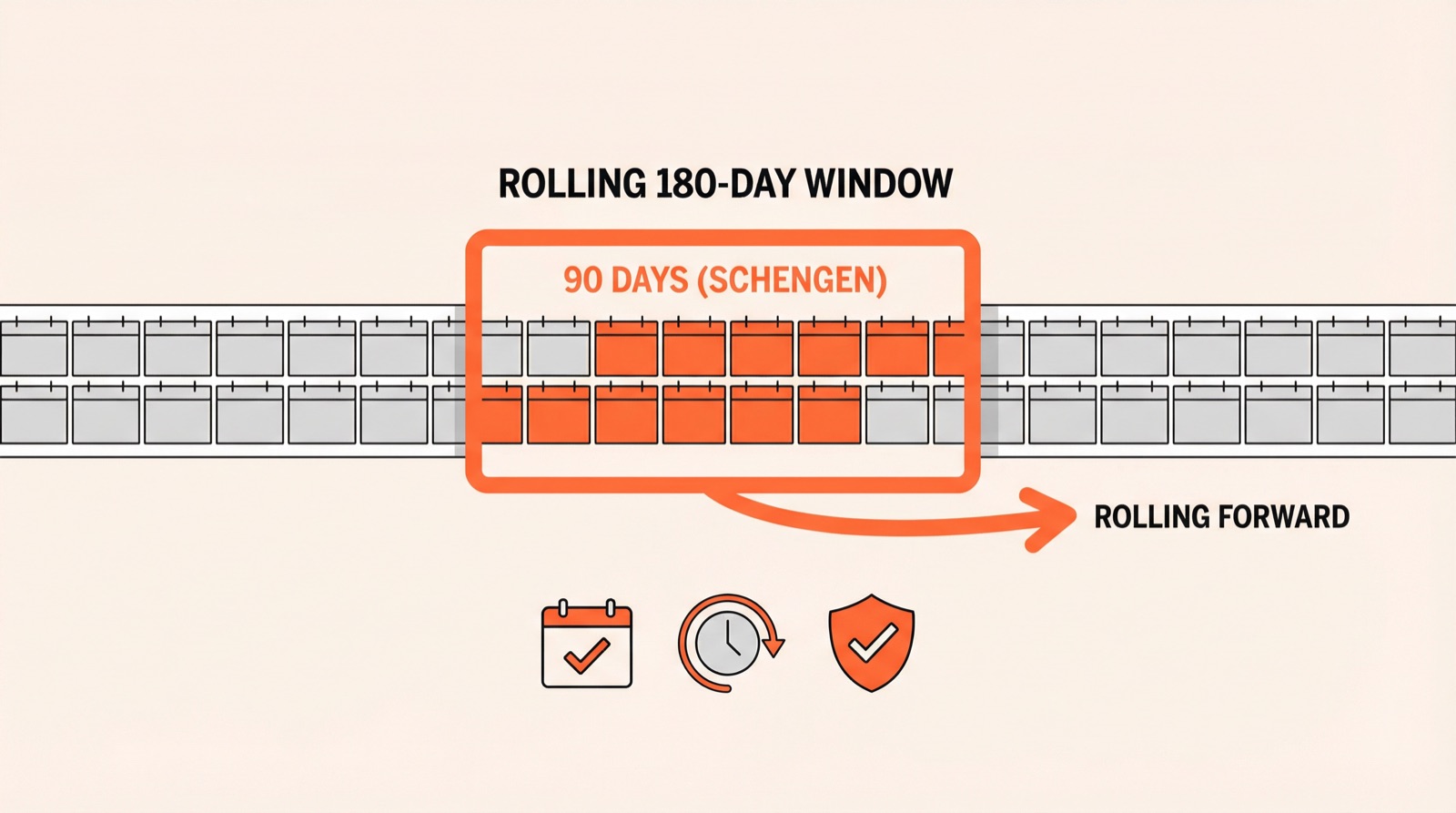
The Schengen 90/180 rule states that non-EU citizens can stay in the Schengen Area for a maximum of 90 days within any 180-day period.
This rule applies to most non-EU nationalities, including citizens of the US, UK, Canada, Australia, and New Zealand, who can enter the Schengen Area visa-free for tourism or business.
The "Rolling" 180-Day Window
This is the most confusing part for many travelers. The 180-day period is not fixed; it's a rolling window that looks back from your current date.
How it works:
- Pick any date (e.g., today).
- Look back 180 days from that date.
- Count the number of days you spent in the Schengen Area during that 180-day window.
- The total must be 90 days or less.
This check must be valid for every single day of your stay.
Example Calculation
Let's say today is June 30, 2026.
- The 180-day window is from January 2, 2026, to June 30, 2026.
Now, let's look at your travel history:
- January 15 - February 13: 30 days in Spain (Schengen)
- February 14 - March 15: 30 days in Morocco (Non-Schengen)
- March 16 - April 14: 30 days in Italy (Schengen)
- April 15 - May 14: 30 days in Croatia (Schengen)
- May 15 - June 30: 47 days in Turkey (Non-Schengen)
Calculation:
- Days in Spain: 30
- Days in Italy: 30
- Days in Croatia: 30
- Total Schengen days in the last 180 days: 90
Result: You have used all 90 of your allowed days. You cannot re-enter the Schengen Area until some of your past Schengen days "expire" by falling outside the 180-day window.
Common Mistakes and How to Avoid Them
Mistake 1: Resetting the Clock
Myth: "If I leave the Schengen Area, my 90 days reset."
Reality: The 180-day window is rolling. Leaving for a day, a week, or a month does not reset your count. You must wait for past Schengen days to fall outside the 180-day window.
Mistake 2: Confusing 3 Months with 90 Days
Myth: "I can stay for 3 months."
Reality: The rule is 90 days, not 3 months. Months have different lengths (28-31 days). Always count individual days.
Mistake 3: Forgetting Entry and Exit Days
Rule: Both the day you arrive and the day you depart count as full days in the Schengen Area.
Example: Arrive on January 1, depart on January 2 = 2 days.
Mistake 4: Not Tracking Layovers
Rule: If you pass through passport control during a layover in a Schengen country, that day counts towards your 90-day limit, even if you're only there for a few hours.
Mistake 5: Ignoring Bilateral Agreements
Some countries (e.g., US, Canada, Australia) have pre-Schengen bilateral agreements with certain Schengen countries that may allow for additional stays. However, these are complex and not consistently applied. Do not rely on them without consulting an embassy.
How to Calculate Your Remaining Days
Manually calculating your remaining days is tedious and error-prone. This is where a Schengen calculator becomes essential.
The Manual Method (Not Recommended)
- Get a calendar and your passport.
- Mark all your entry and exit dates for the Schengen Area over the past 6 months.
- For any given date, count backwards 180 days.
- Sum up all the days you were in the Schengen Area within that window.
- Subtract from 90 to find your remaining allowed days.
This process must be repeated for your planned entry and exit dates to ensure you don't overstay.
The Automated Method: Using a Schengen Calculator
A Schengen calculator automates this entire process. You simply enter your past and planned trips, and the tool does the rest.
Days of Stay's Free Schengen Calculator
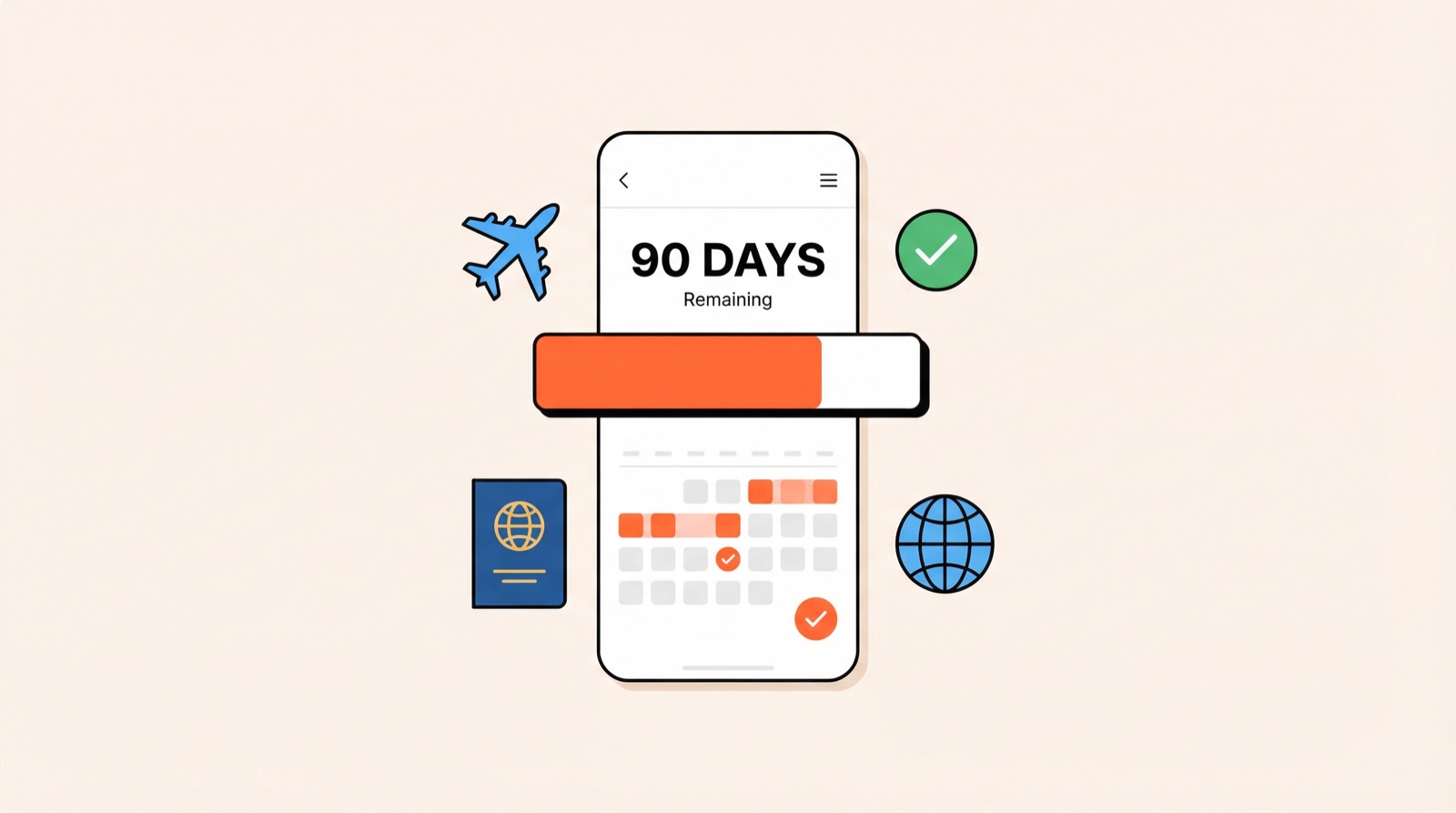
Our app, Days of Stay, includes a free, powerful Schengen calculator that helps you stay compliant.
How it works:
- Enter your trips: Add your past and future travel dates for Schengen and non-Schengen countries.
- Get instant results: The calculator automatically applies the 90/180 rule to your entire trip history.
- See your status: View your total days used, remaining days, and the earliest date you can re-enter the Schengen Area.
- Plan with confidence: The tool will warn you if a planned trip would result in an overstay.
Why use Days of Stay?
- Free and private: No accounts, no tracking, all data stays on your device.
- Accurate: Handles the rolling window and leap years correctly.
- Visual: See your travel history on a timeline.
- Always available: Works on any device with a web browser.
Try the Free Schengen Calculator →
Schengen 90/180 Rule vs. 183-Day Tax Rule
It's crucial not to confuse these two rules:
| Feature | Schengen 90/180 Rule | 183-Day Tax Rule |
|---|---|---|
| Purpose | Immigration & Visa | Taxation |
| Who it applies to | Non-EU citizens | Anyone (including EU citizens) |
| Timeframe | 90 days in any 180-day period | 183 days in a tax year |
| Area | Schengen Area | A single country |
| Consequence | Deportation, fines, travel ban | Becoming a tax resident |
Key takeaway: You can be fully compliant with the Schengen 90/180 rule but still become a tax resident in a European country by spending 183+ days there.
For a deep dive into tax residency, read our guide: What is the 183-Day Rule? Complete Tax Residency Guide 2026
Frequently Asked Questions
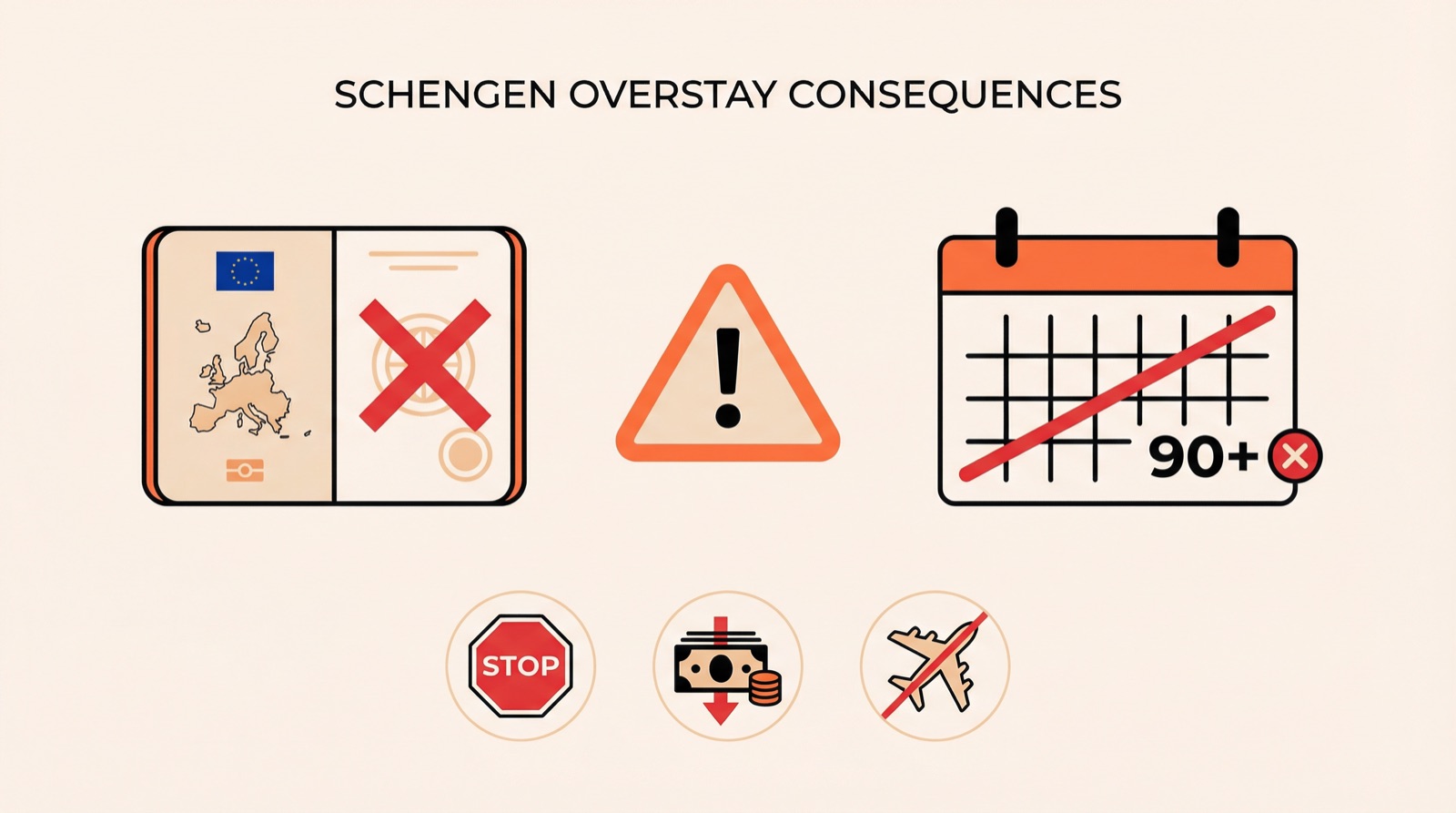
Q1: What happens if I overstay my 90 days?
Consequences vary by country but can include:
- Fines (from €100 to over €1,000)
- Deportation at your own expense
- An entry ban for the entire Schengen Area (from 1 to 5 years)
- A permanent record of the overstay, making future visa applications difficult
Q2: Can I extend my 90-day stay?
Extensions are only granted in exceptional circumstances, such as a medical emergency or a natural disaster. You cannot extend your stay for tourism or convenience.
Q3: Does time spent in non-Schengen EU countries count?
No. Time spent in EU countries outside the Schengen Area (Ireland and Cyprus) does not count towards your 90-day limit. Bulgaria and Romania are full Schengen members since January 2025, so days there do count.
Q4: I have a long-stay visa for one Schengen country. Does the 90/180 rule still apply?
If you have a long-stay (Type D) visa or a residence permit for a Schengen country, you can reside in that country for the duration of your permit. For travel to other Schengen countries, the 90/180 rule still applies.
Q5: How do EES and ETIAS affect the 90/180 rule?
They are two different systems, and neither changes the rule itself:
- EES (Entry/Exit System) records your entry and exit dates electronically, together with your facial image and fingerprints. It was rolled out over six months and has been fully operational at all external Schengen borders since 10 April 2026; manual passport stamps were abolished on that date. EES calculates the 90 days in any 180 as one period across all 29 countries and automatically flags overstays, so enforcement is now much stricter than with stamps.
- ETIAS is a pre-travel authorisation for visa-exempt travellers, not a visa and not an entry/exit record. As of October 2026 it is not in operation yet; the EU will announce the start date several months in advance. The application fee will be €20.
Sources: EES FAQ and What is ETIAS on the official EU travel website.
Conclusion: Track, Don't Guess
The Schengen 90/180 rule is complex, but with the right tools, it's manageable. The key is to be proactive and track your days meticulously.
- Always count days, not months.
- Remember the rolling window—the past 180 days matter.
- Count entry and exit days as full days.
- Use a reliable calculator to avoid manual errors.
By using a tool like the Days of Stay Schengen Calculator, you can automate the process and travel with peace of mind, knowing you're always compliant.
Don't let a simple calculation error derail your European travels. Start tracking today!
Related Articles
- What is the 183-Day Rule? Complete Tax Residency Guide 2026
- How to Track Tax Residency: 5 Proven Methods
Last updated: December 2026
Disclaimer: This guide provides general information. Immigration rules can change. Always consult official government sources or an immigration lawyer for advice specific to your situation.